
Cryptocurrency Privacy Guide
Research-based analysis of privacy coins used on darknet markets. Understanding why Monero XMR became the standard for anonymous transactions.
Why Cryptocurrency Privacy Matters
The relationship between darknet markets and cryptocurrency has defined both industries. When Silk Road launched in 2011, Bitcoin was the only viable option — but its transparent public ledger proved catastrophically incompatible with anonymity requirements. Every transaction visible on-chain, every wallet cluster analysis narrowing identity attribution.
The DrugHub Darknet market's exclusive adoption of Monero XMR represents the culmination of a decade-long cryptographic arms race between privacy advocates and chain-analysis firms. Unlike Bitcoin, XMR transactions are opaque by default — amounts, senders, and recipients are all obfuscated through layered cryptographic techniques.
This guide examines the technical foundations of cryptocurrency privacy, the specific mechanisms that make Monero the preferred asset on markets like DrugHub Market, and the practical steps for acquiring and using XMR with maximum anonymity.
Privacy Comparison
| Feature | Monero (XMR) | Bitcoin (BTC) | Zcash (ZEC) |
|---|---|---|---|
| Transaction Amounts | ✓ Hidden (RingCT) | ✗ Fully Visible | ~ Optional Shielding |
| Sender Identity | ✓ Ring Signatures | ✗ Address Visible | ~ Partial Protection |
| Recipient Identity | ✓ Stealth Addresses | ✗ Address Visible | ~ Shielded Pools |
| Privacy by Default | ✓ Always Private | ✗ Always Transparent | ✗ Optional |
| Chain Analysis Resistance | ✓ High | ✗ Low | ~ Moderate |
| Market Adoption | ✓ Dominant | ✗ Declining | ✗ Minimal |
Monero Technical Architecture
Ring Signatures
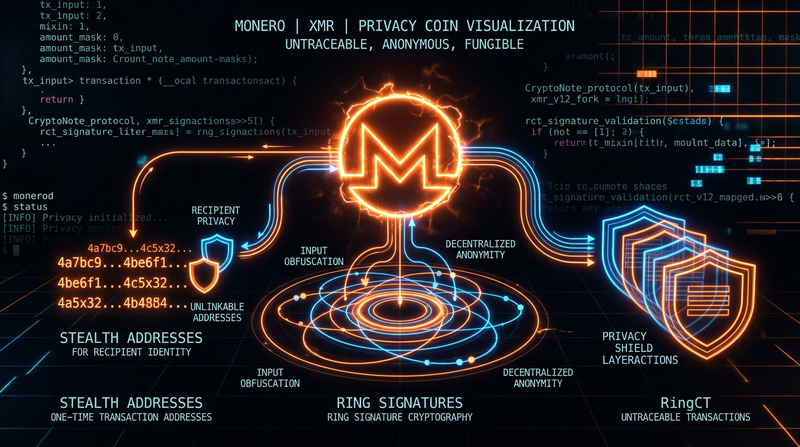
Each XMR transaction is signed by a group of possible signers (the "ring"), making it computationally infeasible to determine which participant actually authorized the transaction. The default ring size of 16 provides strong sender unlinkability.
Stealth Addresses
Every transaction generates a one-time address on the recipient's behalf. The recipient's public address never appears on-chain, and each payment goes to a unique ephemeral address derived through Diffie-Hellman key exchange.
RingCT (Confidential Transactions)
Transaction amounts are hidden using Pedersen commitments — a cryptographic scheme that allows validators to confirm transactions balance without revealing the actual values. Introduced in 2017, now mandatory for all XMR transactions.
Bulletproofs
An efficient zero-knowledge proof system that reduces transaction size by over 80% compared to original range proofs, while maintaining full privacy. Bulletproofs+ (2022) further optimized verification speed.
Dandelion++
A network propagation protocol that obscures the originating IP address of transactions by routing them through a randomized path before broadcast. Prevents network-level transaction attribution.
RandomX Algorithm
Monero's proof-of-work algorithm is optimized for general-purpose CPUs, making ASIC mining impractical. This supports network decentralization, reducing the risk of mining cartel attacks on network integrity.
Acquiring XMR Anonymously
This section documents known methods for acquiring Monero with varying degrees of privacy. This is strictly informational — each method has different risk profiles and legal considerations depending on jurisdiction.
P2P Exchange (LocalMonero)
Peer-to-peer exchanges allow trading XMR directly with individuals using cash, gift cards, or other methods. No KYC required. Variable liquidity. Always meet in-person for cash trades or use escrow-backed online trades.
Mining XMR Directly
Mining Monero with a CPU produces XMR that has no exchange history. Coins mined directly are fungible and carry no prior transaction metadata. Profitability depends on hardware and electricity costs.
Atomic Swaps (BTC→XMR)
Trustless cryptographic swaps between Bitcoin and Monero without a centralized exchange. Removes custodial risk. The BTC side remains transparent, but XMR received is unlinkable once on-chain.
Centralized Exchange + Conversion
KYC exchanges link your identity to the purchase. Withdrawal to a self-custody XMR wallet severs the chain-analysis link, but exchange records persist. Not recommended for high-sensitivity use cases.