
Monero XMR — Complete Privacy Guide
Deep technical analysis of Monero's cryptographic privacy architecture: the standard for anonymous transactions on darknet markets including DrugHub.
What is Monero?
Monero (XMR) is an open-source, privacy-focused cryptocurrency launched in April 2014. Unlike Bitcoin — where all transactions are visible on a transparent public ledger — Monero uses advanced cryptographic techniques to ensure that transaction amounts, sender identities, and recipient identities are all private by default.
This fundamental design difference is why the DrugHub Darknet market, like most privacy-conscious platforms, exclusively accepts XMR. The inability to perform chain analysis on Monero transactions eliminates one of the primary vectors through which law enforcement has historically attributed market activity to real-world identities.
Monero is traded on multiple exchanges under the ticker XMR and has maintained a position as the leading privacy cryptocurrency by adoption, development activity, and market capitalization since 2016.
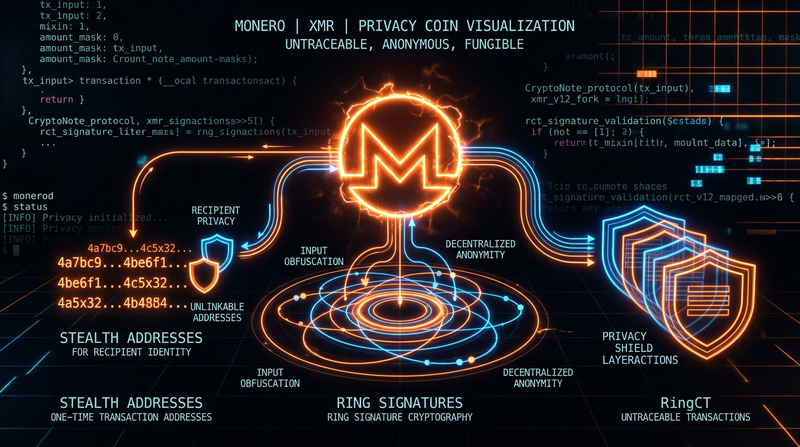
Privacy Mechanisms
01. Ring Signatures
When you send XMR, your transaction is signed by a group (ring) of addresses drawn from the blockchain's decoy pool. An observer cannot determine which ring member is the actual sender — only that one of them authorized the transaction. The default ring size of 16 decoys has been mathematically analyzed to provide strong sender privacy against probabilistic chain-analysis attacks.
02. Stealth Addresses (One-Time Keys)
Every Monero transaction generates a unique one-time public key for the recipient. The recipient's wallet scans the blockchain using their private view key to detect incoming funds, but no on-chain observer can link the payment to the recipient's public address. This prevents address clustering — a primary Bitcoin deanonymization technique.
03. RingCT (Ring Confidential Transactions)
Introduced in January 2017 and made mandatory by September 2017, RingCT hides transaction amounts using Pedersen commitments. Validators can cryptographically verify that inputs equal outputs (no coins created from nothing) without knowing the actual values involved. This closed the final major privacy gap that existed in early Monero versions.
04. Bulletproofs & Bulletproofs+
Bulletproofs are zero-knowledge range proofs that prove transaction amounts are positive without revealing them. They reduced transaction size by ~80% versus the original Borromean range proofs. Bulletproofs+ (deployed 2022) further reduced verification time and transaction weight, improving scalability without sacrificing privacy.
05. Dandelion++ Network Protocol
When a Monero node broadcasts a transaction, it first propagates through a randomized "stem" phase — a linear chain of nodes — before entering the standard "fluff" phase of diffuse broadcast. This makes it significantly harder for an adversary monitoring the network to identify the originating IP address of a transaction.
06. Kovri / I2P Integration (Planned)
The Monero project has long planned native I2P integration to route all node communications through an anonymizing overlay network. While full integration remains in development, third-party solutions allow running Monero nodes over Tor or I2P for additional network-level privacy.
Wallet Selection Guide
Choosing the right wallet is critical. For use with platforms like DrugHub Market, self-custody wallets with Tor support are strongly recommended. Never use exchange wallets for privacy-sensitive purposes.
Feather Wallet (Desktop)
Lightweight Monero wallet with built-in Tor support. Open-source, audited, fast sync via remote nodes. Ideal for users who want full XMR features without syncing the entire blockchain locally.
- Built-in Tor integration
- No blockchain download required
- Hardware wallet support
- Available: Windows, macOS, Linux
Official Monero GUI Wallet
The reference implementation from the Monero project. Supports full node operation for maximum privacy — no trust in third-party nodes required. Best for advanced users with sufficient storage.
- Full node option for maximum privacy
- Battle-tested codebase
- Tor/I2P compatible
- Available: Windows, macOS, Linux
Cake Wallet (Mobile)
Open-source mobile XMR wallet. Convenient for checking balances and receiving payments on-the-go. For maximum privacy, connect to your own node rather than the default remote node.
- iOS and Android support
- Custom node connection
- Built-in exchange features
- Open-source codebase
Ledger Nano X (Hardware)
Hardware security module supporting Monero. Private keys never leave the device. Best cold storage option for significant XMR holdings. Requires companion software for transaction signing.
- Air-gapped key storage
- Physical confirmation required
- Monero app available
- Use with Feather or GUI wallet
Receiving Payments on DrugHub
This section documents how XMR payment flows work on markets like DrugHub Darknet — for educational understanding of the technical transaction lifecycle. This is informational only.
Each order generates a unique one-time subaddress. The market platform derives this from your wallet's public spend key, ensuring funds only you can access.
Transfer exact XMR amount to the generated address. Include a small buffer for transaction fees. Allow 2-10 minutes for standard confirmation (2 blocks).
Funds are held in the platform's multisignature escrow contract. Neither buyer, seller, nor platform can unilaterally release funds — requiring cooperative or arbitrated signatures.
Upon delivery confirmation or dispute resolution, the escrow releases funds to the vendor's withdrawal address. The entire transaction history appears on-chain as unlinkable ring signature entries.